|
|
“BEST AND WORST STORIES” -- WHAT’S THE BIG DIFFERENCE BETWEEN STRIPED BASS AND ATLANTIC SALMON?
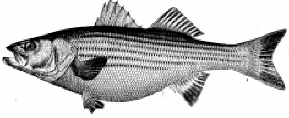
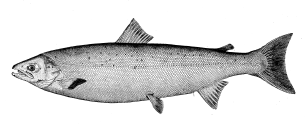
(Striped bass (left) and Atlantic salmon (right) - pictures from NMFS) The resurgence of the striped bass, mainly off the coast of New England, is the favorite example given today as evidence of the effectiveness of modern fisheries management and conservation methods. The Atlantic salmon, on the other hand, is disappearing so fast that proposals are being considered to have it listed as an endangered species. The two fish are at the extreme ends of the “healthy fish stock” spectrum, yet they seem to share some common features at first glance. What is the difference, the REALLY BIG DIFFERENCE, that has determined the current success of the striped bass and the pathetic failure of the Atlantic salmon? A look at the two fisheries and their management histories might help answer the question. So also might a look at the fish. The striped bass and the Atlantic salmon, so very different in their “luck” these days, actually share a surprising number of characteristics. There are differences to be sure, but first here’s what I see that these two fish have in common. - CONSERVATION - Serious attempts have been made by fisheries managers for quite a few years to conserve the stocks of striped bass and Atlantic salmon. Both fisheries have been severely restricted in recent years in hopes of allowing the fish to rebuild their numbers. It may be safe to say that both striped bass and Atlantic salmon have enjoyed similar levels of “protection.” - SIZE OF FISH - both of these can grow quite large, up to 30 pounds with record weights being much higher. The “record” striped bass was much bigger than the biggest Atlantic salmon. Both species are therefore fairly large fish. - AGE AT MATURITY- both striped bass and salmon do not reproduce until they are 4 - 5 years old. So neither one has the advantage of reproducing more quickly than the other. - “ANADROMOUS” - both fish live parts of their lives in freshwater (travelling up rivers) and parts of their lives in salt water. The salmon spawns in freshwater streams while the striped bass travel up rivers and spawn near the “head of the tide.” - DIET - both the striped bass and the Atlantic salmon are described as “voracious feeders.” The menu items are almost the same. For the striped bass - “a wide variety of small fishes such as alewives, herring, smelt, eels, flounders, mummichogs, rock eels, sand lance, silver hake, and silversides, and feeds on invertebrates including squid, crabs, seaworms and amphipods...in fresh water they eat insect larvae, young alewives, elvers, and yellow perch.” What does the Atlantic salmon eat? In the sea they eat “herring, lance, alewives, smelt, capelin, small mackerel, small haddock, and others; the crustaceans eaten include euphausiids, amphipods, and some decapods.”- (quotes are from Leim and Scott, 1966) In other words, both of these fish are very versatile carnivores, probably eating anything of the right size that crosses their path. - PREDATORS - Juvenile striped bass are eaten by “other predacious fishes such as silver hake and cod, but as mature fish they have few enemies.” Young Atlantic salmon, while in fresh water, “may be eaten by eels and other predacious fishes and by fish-eating birds...In the sea, salmon have been found in the stomachs of pollock, tuna, swordfish, and sharks. Salmon caught in nets are eaten by seals but there is no evidence that seals feed on salmon that are free-swimming.” It looks like the risks of predation might be similar for the young of both species, and are not great for the mature fish. Striped bass as adults might have an advantage here, but the predators of salmon (pollock, tuna, swordfish, and sharks) are not terribly abundant in the North Atlantic at this time. It’s hard to believe that predation on adults is the deciding factor that has caused such a huge difference in the success of the two fishes. - RANGE - On the North Atlantic coast the range of the Atlantic salmon extends from Labrador to Connecticut, historically they have been known to travel up hundreds of rivers. The striped bass is found from the St. Lawrence River to Florida, also being known to travel into hundreds of freshwater systems. So the range of habitat used by the two fish species overlaps, but the salmon is clearly more of a northern fish and the bass a more southern one. Regarding the quality of the freshwater systems that the fish use, it seems that more of the pristine rivers (no dams or heavy pollution) would be travelled by the Atlantic salmon than the striped bass. So, if pollution of freshwater was the deciding factor between them, it would seem that the bass should be getting the worse end of it. It’s not that nutrient-overloaded rivers don’t exist for the salmon, it’s just that the bass must frequent more of them...regardless, rivers that used to host both fish now essentially host one - striped bass only. *** MIGRATION PATTERNS *** - This is the point where the habits of the salmon diverge the most from those of the striped bass, and I suspect that it is the deciding factor that has caused such a radical difference between their fates. The striped bass is very much a “coastal” fish during its time in the sea, “seldom found more than a few miles from the shore except during spring and fall migrations.” It migrates to the north and eastward along the coast in early spring, and the reverse route in the fall. In late spring the large bass travel up rivers to spawn. During the winter the bass migrate up rivers and overwinter in lakes. The Atlantic salmon spends its early life in the river system and then heads far out to sea. Their usual pattern is to travel long distances in the open ocean, living and feeding in “offshore” areas, only returning to the river to spawn after spending one (but usually 2 or more) winters at sea. The biggest difference that I see between their lifestyles is the coastline-hugging habits of the striped bass versus the pattern of ranging far offshore by the Atlantic salmon. How this relates to their success, I think must be related to the availability of food in their chosen habitats. In the marine ecosystem overall a clear pattern is emerging of fish growing much more slowly offshore than in areas nearer the coast (just one example is the Northern cod where nearshore stocks in Atlantic Canada are experiencing some growth while offshore ones continue to disappear despite a prolonged moratorium...the remaining fish are small and growing very slowly). There is a logical explanation for this picture. The waters nearest the shorelines receive the “benefit” of terrestrial source nutrient runoff, as well as the productivity that is generated in the intertidal zone. We’ve heard a lot about the harmful effects of an oversupply of nutrients to the waters, and I don’t dispute the fact that it can cause (harmful to fish) eutrophication. A certain portion of what nutrients runoff from the land, however, is certainly taken up and used to support the coastal community of marine organisms. That is why there are still enough little fish around near the shore to feed a not-very-picky eater like the striped bass. There is no efficient mechanism however, to transport land-source nutrients to the depleted offshore waters and food levels there are now at very low levels, which explains the “failure to thrive” of the Atlantic salmon along with practically all other offshore species. Certainly the larger fishes, those that subsist by eating smaller ones, are finding it very hard to make a living now in the offshore waters. Evidence suggests that the quantity of organic material being cycled through the offshore food web has been significantly lowered. (I have been told repeatedly that nitrogen - the limiting nutrient in this case - is being added to the ocean in greater quantities than it is being removed by fishing, and that therefore nutrient shortage cannot possibly explain the trends. “N-in” may in fact outweigh “N-out” in the system overall - I’ll not argue the math - but the form and distribution pattern of the “N-in” is not such that it contributes effectively to replacing depleted communities of fish stocks on the offshore banks. An analogy to the “there are plenty of nutrients in the sea, so fish cannot be starving” line would be something like “there is plenty of water on the planet, so the deserts cannot be dry.” Distribution patterns are critical.) What other factors are likely to be playing in favor of the striped bass over the Atlantic salmon? Pressure from striped bass predators may be at an abnormally low level currently, since besides relief from human fishing to a large degree, stocks of their natural predators - the other carnivorous fish - have declined to very low levels. The difference between predator pressure on bass and salmon is probably not great, however, as was already mentioned, and if a difference exists it is most unlikely to be of the magnitude to cause one fish to flourish and the other to disappear. Recent fluctuations in water temperatures have been proposed as a cause of declining fish stocks. Since the temperature changes have not been limited to the offshore waters but have affected coastal waters and freshwater systems as well, it seems rather unlikely to be the major explanation here. Consider the effects of polluted rivers and coastal waters. Undoubtedly both the striped bass and the Atlantic salmon have felt the negative impact of this but, paradoxically perhaps, the more successful fish is the one that spends the most time in the “polluted” coastal waters. Something more lethal than pollution must be happening offshore. Many marine species appear to be resilient creatures that have survived in fluctuating environmental conditions for millions of years, but now they are facing a grave new problem and it’s a lot worse offshore...too far from the source of nutrient input...the basic survival challenge is “find enough to eat or die” and the Atlantic salmon, among other offshore carnivorous fish, now appear to be losing this battle... by Debbie MacKenzie |