|
|
|
Evolving Trends in Marine Algae Populations, seagrasses and other intertidal organisms: Signs and Symptoms of a mounting Nitrogen Deficit in the Ocean? by Debbie MacKenzie July, 2001 "Things are so strictly related, that according to the skill of the eye, from any one object the parts and properties of any other may be predicted." -- Ralph Waldo Emerson (1803-1882)
1.INTRODUCTION: Many signs today, in a wide range of marine organisms, point to dropping levels of fixed nitrogen availability in open ocean seawater. This DEMANDS investigation because the marine nitrogen level is critically important to the health of the global ecosystem. For example, stability in the amount of bioavailable nitrogen in the planetary ocean is one essential factor in the maintenance of the ocean-atmosphere carbon balance (atmospheric CO2 level) (Shaffer, 1993). In this paper, the ranges and conditions of intertidal organisms are suggested as useful indices of seawater nitrogen levels. A close look at individual species of seaweeds and intertidal organisms, repeatedly reveals the specific signs of nitrogen deficiency in their growth patterns and pigmentation changes. It appears that neither the fishing industry, nor the marine scientists that monitor the fish stocks, truly appreciates the dangerous global ecological destabilization that will result from the serious depletion of the marine biota. The fate of marine life will have impacts on human life that extend far beyond the fishing and tourism industries.
The ocean is in very deep trouble, worrisome indicators are appearing everywhere now, yet a clear explanation of exactly what is going wrong still eludes us. A careful examination of the plankton, the seaweed and the intertidal animal life will help to establish the correct diagnosis. Marked shifts, mostly downward, are occurring in marine fish, mammal and seabird populations worldwide, and these changes have been accompanied by a series of alterations in the marine algae community and small "unexploited" creatures as well. Most scientific and media attention, regarding changes in marine algae, has been turned to the recent increasing trend in the occurrence of toxic algal blooms, as well as the proliferation of a couple of invasive green seaweeds, in diverse areas of the globe. Caulerpa taxifolia and Codium fragile are perhaps the most prominent green "invasive" seaweeds. Multiple species are involved in the toxic algal blooms, but a common theme can be seen to underlie all these changes: lower than usual levels of nitrogen are available to algae in the seawater, and this deals an advantage to today’s emerging dominant strains of marine algae. This paper considers the possibility that declining nitrogen availability in seawater may be contributing to "forcing" these changing trends in algal growth. Caulerpa and Codium species both have unusual strategies for obtaining nitrogen in nutrient depleted waters, which gives them a clear competitive advantage over the previously dominant brown seaweeds. The microscopic toxin-producing algae that are involved in the toxic blooms, for example Gymnodinium species, frequently are found to belong to a class of organisms (cyanobacteria) that grows to advantage in LOW ambient nitrogen conditions due to their capacity for making use of atmospheric nitrogen (nitrogen fixation). 2. Nitrogen Deficiency in the Sea? The hypothesis that nitrogen shortage has developed in the sea, however, goes directly against most current thinking on the topic. Due to the fact that humans are increasingly flushing great quantities of nitrogen (fertilizer and sewage) into the sea via rivers, the commonly accepted conclusion is that an overload of nitrogen, rather than a shortage, is at the root of the problem. Therefore, how can this author arrive at such a contrary conclusion?The most important observation is that coastal DENITRIFICATION ultimately removes the vast majority of the nitrogen waste that we flush into the sea. This is so effective that it effectively "decouples" the terrestrial and marine nitrogen cycles. The nitrogen in our sewage does NOT enter the living marine food web, rather it ends up in the bottom sediment or returned to the atmosphere. "Although nutrient loading has resulted in coastal eutrophication on a global scale, denitrification presently removes virtually all land-derived nitrogen before it can reach the open ocean. Coastal denitrification thus effectively decouples the terrestrial and oceanic nitrogen cycles." (Falkowski, 2000, Vitousek, 1999) Therefore the oceanic system, which is generally N-limited, must rely on its own devices (nitrogen fixation) to replace nitrogen lost through human fishing. The critical role of the living marine biota in absorbing CO2 from the atmosphere and thereby stabilizing the atmospheric concentration, is fairly well appreciated by climate scientists (e.g. Shaffer, 1993, Trabalka,et al., 1985). Current carbon-cycle models assume that marine biological "primary production" has remained constant since preindustrial times, but all evidence points towards the conclusion that this is EXTREMELY unlikely to be true. ("Primary production" refers to the uptake of CO2 during photosynthesis, a process that relies directly on the fertilizing effect of nitrogen). "IF" fishing ultimately caused nitrogen-depletion in the sea, that nitrogen-depletion would inevitably result in a slowing of the rate of primary production...and therefore fishing would be directly implicated in rising atmospheric CO2 levels. These aspects of marine ecology have been argued in detail elsewhere on this website, it has been shown how human fishing/biomass removal has likely interrupted the normal nitrogen cycling in the ocean ( The Marine Nutrient Cycle). The close temporal parallel between the history of the expansion of the fishing industry and rising atmospheric CO2 has also been described ( Effects of Fishing and Whaling on Atmospheric CO2). These points emphasize the critical importance of discovering/understanding whether or not there has been a decrease in the "inventory of bioavailable nitrogen" in the ocean. The purpose of the current paper is not to repeat those arguments, but rather to demonstrate how consistent today’s changing trends in marine algae and intertidal lifeforms are with changes that would be predicted "IF" the ocean experienced a lowering of available nitrogen. The realization that available nitrogen is almost certainly dropping at sea allows us to draw together many seemingly unrelated threads in the story...and a close examination of the smaller details helps to bring the larger picture into clearer focus. Considered as indicators of trends in nitrogen availability in seawater will be: 1. Changing patterns in the makeup of the global marine macroalgae (seaweed) community. 2. The global declining trend in sea grasses: eelgrass and salt marshes. 3. The decline of the barnacle belt on rocky exposed NW Atlantic shores in Nova Scotia. 4. Changing growth patterns and pigmentation in seaweeds along this same Nova Scotian coast. 5. The global increasing occurrence of harmful, often toxic, marine phytoplankton blooms. Following is a brief global overview of the most remarkable changes in seaweed populations, plus a closer examination of the changes that have occurred in one northern temperate zone. Today’s changing trends in macroalgae are compared to the changes that would be predicted to occur if the availability of N to algae growing in ocean waters was declining. Declines in oceanic levels of zooplankton (and also fish, and invertebrates) offer a clue as to why seaweeds may be experiencing nitrogen shortage. All of these living organisms excrete NH4, ammonia, which is the form of nitrogen fertilizer most readily assimilated by marine algae. Beyond dependence on bottom-to-top mixing patterns to make nutrients available in surface waters, the very fact of the existence of marine animals ensures and moderates the supply of fertilizer to these plants. Marine algae therefore depends on its normal coexistence with marine animal life. The affinity of many smaller organisms to living in seaweed habitat ensures the physical proximity of the fertilizer-excreters to the marine plants that thrive on it; this is one of many expressions of the natural interdependence of plants and animals. 3. The Predicted Pattern of Changes
Nitrogen is an essential fertilizer for plants, including all varieties of marine algae. If seawater gradually provided less usable N to these organisms, signs of increasing N-limitation or N-deficiency would be expected to occur in algae populations. Predictable shifts would be these:
Measurable biochemical indicators will help to verify or refute this author’s deduction that marine algae are now growing in relatively nitrogen depleted medium. Studies could reasonably be done now to compare the biological indices of nitrogen-nutritional status of seaplants today with earlier measurements that were done on these species decades ago. Beyond the scope and abilities of this author at this time, these comparative studies would be very useful. (Examples would be C/N ratios, protein content, and perhaps DNA/RNA ratios on some organisms.)7. Plants having alternate strategies for obtaining N (methods beyond direct absorption from the seawater into the flesh of the plant) - these will possibly increase in abundance. This includes plants with symbiotic associations with cyanobacteria (like Codium fragile, and some species of Caulerpa) and plants with true roots, siphonophores that can draw up nutrients from the bottom substrate (like Caulerpa taxifolia). Similarly, algae that can utilize a wider range of N-species will be at a competitive advantage (e.g. Codium fragile, which, unlike many other algae, can uptake NO3-, NO2- or NH4+, making it a more versatile N-scavenger. (Lobban and Wynne, 1981)). 8. Algae naturally adapted to, or requiring for their growth, low N conditions (oligotrophic water) will compete more successfully for space. Those that thrive in oligotrophic tropical and sub-tropical waters may expand their ranges to higher latitudes as nutrient levels decline in these zones and fall more into line with what the tropical organisms are accustomed to. Temperature tolerance will undoubtedly limit the extent of their range expansion, but those tropical types with greater cold-tolerances will be expected to increase in abundance outside of the tropics. Specifically, changes in the relative abundance of various types of coralline algae might be observed. Coralline algae species vary in their reactions to changes in nutrient availability, some will be stimulated and some will be inhibited by nutrient enhancement of water (Johansen, 1981). 9. Cyanobacterial colonies, free floating types and benthic mats, will naturally become increasingly abundant as seawater declines in N-content. Very low N-availability is a requirement for the growth of these organisms. (Carpenter et al, 1991, Stal and Caumette, 1993, Lassus et al., 1995, Desikachary, 1972). As benthic habitats are abandoned by other organisms, cyanobacteria can be expected to colonize these "new," empty spaces. Cyanobacteria are the only class of marine organisms that can "fix" nitrogen. Therefore, under conditions of increasing nitrogen depletion, they will be increasingly be called upon to "fix" the nitrogen-starved condition of the system as a whole. An increase in the overall abundance of marine cyanobacteria is therefore predicted.
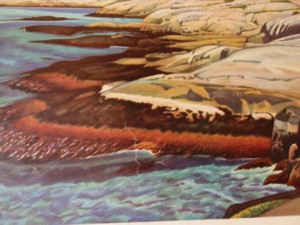
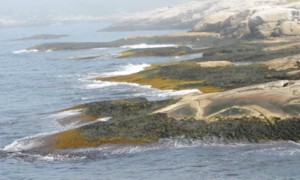
5. CHANGES NOTED IN THE COMMUNITY OF INTERTIDAL ORGANISMS IN A NORTHERN TEMPERATE ZONE, OVER THE LAST HALF CENTURY Latitude: approx. 44 degrees north Longitude: approx. 63 degrees west These co-ordinates identify a point on the rocky coast of Atlantic Canada where this author spent her childhood, a very small fishing village with no major sources of pollution in the vicinity. This area experiences open exposure to the North West Atlantic ocean. The marine life in this intertidal zone is the group that I know best. A recent survey reveals some large changes, when compared with memories from the 1960s and 1970s. Even "serious" science these days, resorts to anecdotal information from human memory when rigorous scientific records are simply not available for comparison. It is a valid approach when it is all one has to work with. My comments on the relative abundance of species are therefore necessarily subjective. In the 1960s-1970s the familiar seaweeds were predominantly rockweeds, which were in shades of brown and greenish brown to golden brown. Kelp and Irish moss grew in rocky exposed areas with more wave action. These two seaweeds were in shades of deep brown, the kelp showing a yellow-orange tint and the Irish moss tending from deep reddish brown to dark purple. The one green growth was the beds of eelgrass that grew in shallow sheltered areas just below the low tide margin. Periwinkles, blue mussels, barnacles, dogwhelks, anemones and starfish were abundant. The starfish was an orange variety that grew to quite a large size. Also common were crabs in a wide range of sizes, along with small fish, minnows, sculpins, and small flatfish. Sandy bottom was riddled with clam holes, and it was very easy to dig out the soft shelled white clams. Today, the first change that one notices in the intertidal zone is the presence of much more "color" than was there in the past. For example, in areas that were traditionally covered in various shades of brown, there are now many more "greens" visible than there were a few decades ago, this despite the disappearance of the traditional green plant, the eelgrass. The green colors showing in the intertidal zone today are from cyanobacterial growths, new species like Codium fragile, free-floating green filamentous growths, and abundant examples of Ulva and Enteromorpha, two paper thin and delicate, bright green annuals. Rockweed and Irish moss are also showing shades of green to various extents. Also, bright yellow and golden tones are increasingly appearing among the "brown" seaweeds. A particularly eye-catching change in some brown seaweeds has been the recent appearance of RED patches. (edit note Oct, 2002 - since this document was originally heavily overloaded with pictures, most of them have now been removed and placed in the Seaweed Photo Galleries.) 6. Peggy's Cove, Nova Scotia. The most interesting observations can be made by comparing historical records from a single location. This sort of detailed record can be difficult to find, but it does exist for at least one popular and easily accessible bit of rocky coastline, one that is exposed to the open North Atlantic ocean: Peggy’s Cove, Nova Scotia. Most tourists and artists have focused on recording the crashing waves, but in 1948 marine scientist T. A. Stephenson visited Peggy’s Cove and meticulously recorded the intertidal life that he observed there at the time.Stephenson’s book "Life Between Tidemarks on Rocky Shores" (1972) describes his life work, elucidating the themes and patterns in organisms living on rocky shores worldwide. Stephenson illustrated the intertidal growth at Peggy’s Cove in 1948 in a painting (possibly due to the limitation of black and white photography in recording the subtle variations in the shades of brown?) The large granite slope that he focused on, on which he documented the prominent barnacle belt above the rockweed, will be referred to in this paper as "Stephenson’s rock." Comparing this painting to my recent photographs, taken 53 years later, reveals his close attention to detail in recording the morphology of the rock. Therefore one can probably conclude that Stephenson’s recording of the appearance of the seaweed and barnacles in 1948 was similarly accurate. Stephenson, along with other scientific sources on exposed rocky coastlines, described the characteristic zonation of organisms that are found there. Life on the "extremely exposed" rocks at Peggy’s Cove illustrates this "zoning" tendency very well, and some remarkable changes have taken place over that last 50 years. From highest to lowest locations, the zones are barnacle belt, rockweed belt, Irish moss belt and kelp belt.
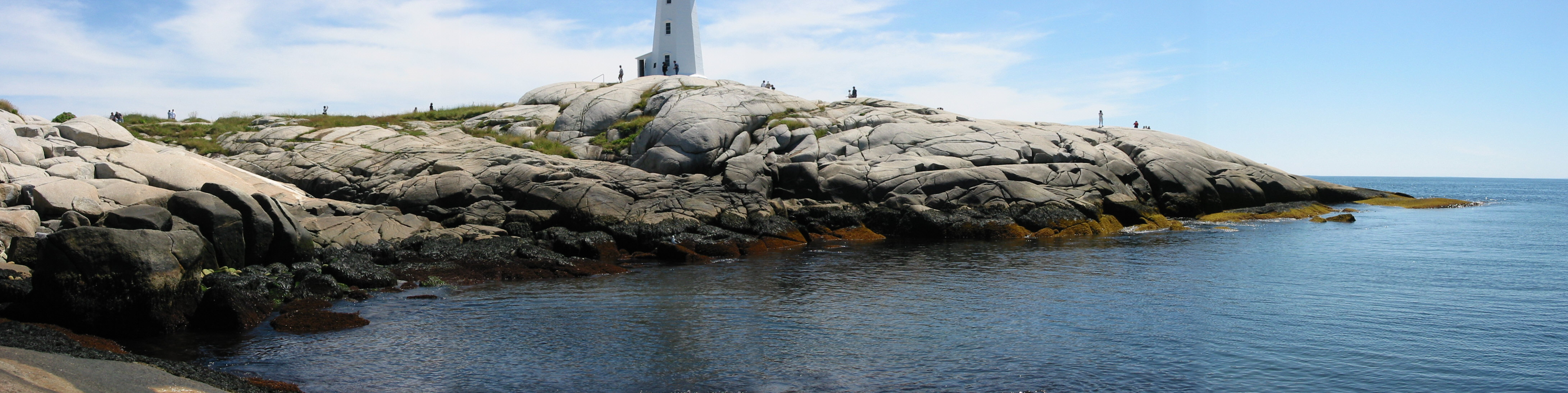
7. Barnacle Belt: At first glance, the difference between the pictures from 1948 and 2001 seem to indicate that the "barnacle belt" above the rockweed zone has disappeared. When Stephenson visited Peggy’s Cove, a heavy encrustation of bright white barnacles extended to a level on the rock significantly higher than that inhabited by the rockweed (fucus). And marine biology texts consistently describe the upper limit of the barnacle zone as reaching above the rockweed zone. Heavy encrustation of barnacles can still be found on our rocky coasts, but it is generally necessary to look within the rockweed zone to find them. Growth of barnacles at a level higher than the upper rockweed has been practically eliminated in areas where it was once common. Barnacles are small, permanently attached crustaceans that live by "suspension" feeding. They reach out and grab whatever edible particles they can from the water that passes over them. Their food is therefore largely plankton, and the recent decline in oceanic zooplankton would be expected to be reflected in a decline of barnacles as they become food limited. How closely the barnacle zone approximates the high tide level on rocky, exposed coastlines, therefore, might present a useful index of the health and richness of the ocean water and marine ecosystem as a whole. A drop in food availability would force a gradual downward contraction in the range of the barnacle…and this appears to be exactly what has happened. Since barnacles can only feed when covered by water, those individual barnacles living highest on the rocks are the ones that endure the longest fasting period between high tides…and therefore they will predictably be the ones to disappear first as the sea becomes nutritionally impoverished. The other important quality of the seawater, from the point of view of the barnacle, is the fact that it is moving. Moving water presents a much more advantageous feeding scenario for a suspension feeder than does relatively still water. It is much easier for a barnacle to grab enough edible particles when they are moving by in a constant stream, than when the animal is limited to what it can reach in unmoving water. (Barnacles typically do not grow in sheltered areas with no wave action; the rocky exposed shoreline is their optimum natural habitat.) So, the distance photo from 2001 initially appears to show no barnacle belt on Stephenson’s rock. But a closer look at the rock itself reveals that some barnacles do still live there above the rockweed zone. And the distribution of the few remaining barnacles in the former "belt" is interesting. Constant wave action is a major feature of this habitat. Areas with higher water flow patterns, specifically the crevices in the rocks, sections that natually drain off relatively more water than the flatter areas as the ocean waves recede, these are the spots on the rock where the few remaining upper barnacles live. This new distribution pattern of barnacles is clearly related to volume and velocity of water flow and its feeding implications for the animal. If we were to entertain explanations such as "global warming" or "increased UV radiation" for the disappearance of the upper level barnacles, it would be very difficult to see how a distribution pattern such as this one would be produced in today’s reduced barnacle population. 8. Rockweed: Stephenson described the rockweed (fucus) zone as "blackish," and it frequently still does give that color impression. A close comparison of the two pictures seems to indicate that the upper level of the fucus zone may have receded slightly, but only slightly, in the last 50 years. It is interesting to note that the spray zone (buff colored rock above the "barnacle belt" with patchy greyish coloration) appears to reach higher now. This is consistent with recent scientific claims that there has been a gradual increase in sea level. But the rise in sea level appears not to have been accompanied by a (possibly expected?) rise in the upper limit of the fucus zone. The overall width of the fucus zone appears to be somewhat less now. This is most easily appreciated when looking at the profile of the outer slope of Stephenson’s rock. In 1948 the fucus belt appeared to be about three times as wide as the next highest belt, the Irish moss (chondrus crispus). Today the Irish moss belt appears to be significantly wider, a view of the same slope gives the impression that it now has approximately the same width as the fucus belt. This is most likely because the rockweed plants are shorter now, and therefore they no longer drape down and cover the Irish moss belt to the same extent at low tide. (Rockweeds are long lived perennials, single plants potentially living for decades; the difference in the length of the rockweed plants is therefore most unlikely to be due to the fact that my photos were taken in July while Stephenson’s record was made in September.) While the typically rough water at Peggy’s Cove may normally contribute to a tendency to smaller growth of rockweed plants, it appears that they grew noticeably bigger and more abundantly in this same environment in the past. This supports the hypothesis that the decrease in growth may be due to a decreasing availability of nutrients to these plants. (See rockweed photo gallery, and updated article on deteriorating rockweeds in Nova Scotia.) 9. Irish moss (Chondrus crispus): Besides the dramatic loss of the barnacle belt, the most glaring difference in the two pictures lies in the changing color and growth pattern of the Irish moss. Stephenson describes the belt of Irish moss as "reddish brown." And his illustration shows a gradation of shading of this color, from a darker hue in the lower plants to a somewhat lighter hue in those living at higher points on the rock. (Well nourished, healthy Irish moss, usually found today in the relatively deeper locations, has a deep purplish-brown color with bluish phosphorescent glints when viewed underwater. As the level of nutrients (nitrogen) available to this plant become less, the color gradually lightens to a lighter reddish brown, then taking on shades of green and gold, and ultimately turning white if nutrient starvation is severe. This pattern of color change in Irish moss as an indicator of nutritional status is well documented in the seaweed literature. (e.g. Lobban and Harrison, 1994)) Today, Stephenson would need to mix a considerable amount of green, yellow and white into his palette to accurately reproduce the color of the Irish moss at Peggy‘s Cove. The gradual increase in the greenish-yellow color of Irish moss was one thing that has become noticeable in other areas, but the picture in Peggy’s Cove turned out to be particularly revealing. The green color of Irish moss today contrasts markedly with my memories of thirty years ago as a teenaged Irish moss "raker." During the summer months at that time, people in this area, including this author, earned a few dollars harvesting, drying and selling Irish moss. The boatload of freshly harvested moss, however, never had a green color. It was consistently reddish to purplish brown. Those same moss beds now prominently exhibit bright shades of green and yellow…even to white in some areas… and the growth appears to be very scanty. Growth of Irish moss was much more lush in the past. Pulling the rake that we once used, through today’s Irish moss beds, would clearly produce only very sparse results. In some areas the growth of Irish moss is so minimal that it looks as if it may have already been "raked," as in the photo below, right. But this patch of moss has not been raked; the local harvest was stopped at least twenty years ago. The typical top to bottom shading pattern is evident in the Irish moss at Peggy’s Cove today, although the range of colors overall is lighter and greener than it was 30 or 50 years ago. Beyond top to bottom shading gradations in the Irish moss, however, another shading gradient is evident at Peggy’s Cove. As you move in, away from the outer rocks of Peggy’s Point itself, the greenish Irish moss takes on an increasingly dark brown hue. It gives the appearance of being relatively better nourished. (It is an established fact that more highly fertilized Irish moss will attain a deeper color, more like the color that was "normal" for this plant over this whole area several decades ago.) The darker Irish moss is actually better "fed" Irish moss. Stephenson’s rock borders one side of a shallow cove that sits at the foot of a large funnel shape in the granite. The other side of the cove and funnel is bordered by Peggy’s Point, the rock that the famous lighthouse sits on. Peggy’s Point juts out into the ocean farther than Stephenson’s rock but the two granite formations define the outer reaches of the "funnel" at Peggy’s Cove. (See photo of Peggy's Point at beginning of the article, or large panoramic shot (972KB).) My photos and Stephenson’s painting depict an usually calm and quiet ocean state at Peggy’s Cove. When the tide and the ocean swells are higher, huge waves are channelled far up into the rocky funnel. The effect can be spectacular. Large volumes of seawater fill the funnel, waves rushing in and reaching surprising heights (and on several occasions sweeping unsuspecting people to their deaths in this spot). This natural funnel formation amplifies the water flow in this specific area. Encouraged by the long, relatively less steep rocky slope, and also the converging sides of the approach to the funnel, an unusually large volume of water rushes into this area with each swell and then drains out between waves. The volume and velocity of water that passes over the Irish moss growing on the rocks at the head of the little cove, therefore, is significantly more than the amount that washes the moss growing to either side of the funnel. This difference in volume of moving water, and therefore opportunity to absorb nutrients, is what is reflected by the green to brown color gradient that is displayed by the Irish moss in this area. "The devil is in the details"…meaning, perhaps, that an explanatory theory needs to account for the smaller details, and also that important clues may be hidden therein. The green to brown color gradient in the Irish moss at Peggy’s Cove can plausibly be explained on the basis of the variable nutrient availability due to variations in water flow. How else could it be explained? Just looking at the green moss in other localities, one might speculate that the color change had resulted from an increase in irradiance, for example (a variable that could theoretically cause the greening effect). But the brown moss at Peggy’s Cove receives the same solar radiation as does the nearby green moss…this helps to narrow down the answer to the one theory that best explains this gradual, long-term color change: a gradual, steady decline in the amount of bioavailable nitrogen in open ocean seawater. If the SPATIAL shift in Irish moss color from brown to green, as illustrated in the recent photographs from Peggy’s Cove, can be attributed to a relative lack of nitrogen available to the greener section…then the TEMPORAL shift from brown to green, which has gradually occurred over recent decades as an overall trend, is also probably best explained by the same mechanism: a gradual lowering of the availability of nitrogen to fertilize the plant and produce pigment. The wide color variation in Irish moss, the whole range from dark brownish purple to greenish-yellow and white; this represents another useful index of nitrogen availability in the seawater. Concerns about nutrient enrichment of oceanic water due to terrestrial runoff are overblown today. The impact of such enhancement is limited to the area proximal to the immediate point sources, and the effect of enhanced nutrient availability on brown and red seaweeds is the development of a deeper color rather than the loss of pigment, such as what Irish moss is demonstrating today in Atlantic Canada (Lobban and Harrison, 1994). This signal of change in Irish moss fits perfectly with today’s larger marine picture of overall biomass depletion due to nitrogen loss. (See photo gallery of Irish moss photos.) 10. THE RISE OF THE NITROGEN-FIXERS, THE "BLUE-GREEN ALGAE" OR CYANOBACTERIA "Blue-green algae"....this interesting class of organisms appears to be rising in abundance in marine systems today. The label "algae" applied to these "blue-greens," however, may contribute to confusion regarding their natural role in the ecosystem. True "algae" are plants, but "blue-green algae" are not plants, rather they are forms of bacteria that accomplish photosynthesis, or carbon-fixation. More properly called cyanobacteria, the "blue-green algae" also accomplish nitrogen-fixation, a process that no plants are capable of. Because of this feature, their nutritional requirements are much lower than the nutritional requirements of true plants. Plants require bioavailable nitrogen to grow, but cyanobacteria do not, since they can make use of atmospheric nitrogen. Unfortunately, since they are commonly found living together, it seems that algae and cyanobacteria often get lumped together in discussions of "marine algae," (e.g. McCook, 1999) which implies that they respond rather similarly to environmental conditions (especially nitrogen availability). An example of this is the assumption that growth of both categories of organisms is stimulated by the presence in seawater of "extra" nutrients, i.e. sewage runoff. In fact, their responses to increasing levels of nitrogen are markedly different. Growth of plants normally increases if nitrogen becomes increasingly available (marine plants are generally nitrogen-limited), but the growth of cyanobacteria is better stimulated by a LACK of nitrogen. (Carpenter et al, 1991, Stal and Caumette, 1993, Lassus et al., 1995, Desikachary, 1972) In fact, high levels of ambient nitrogen appear to be toxic to cyanobacteria and will ultimately inhibit their growth. Therefore, if a situation existed wherein the availability of nitrogen in the sea was gradually lowered, a shifting trend in the composition of the algae/cyanobacterial community could be predicted. The expected pattern would be an overall increase in cyanobacteria accompanied by a gradual decrease in plant algae. As was briefly mentioned in the introduction, a large proportion of "algae" species that are involved in marine toxic blooms fall under the category of "nitrogen fixers." They are not algae, but cyanobacteria. Their increasing abundance worldwide in the form of "red tides" is well acknowledged (NOAA, Lassus, et al., 1995). The occurrence of these blooms has been closely studied in recent years, and the common feature preceding their formation is always a period of calm warm weather, a time in which the water becomes increasingly thermally stratified and the surface layer becomes extremely nutrient depleted. The virtual absence of nitrogen in the immediate seawater appears to be the necessary trigger to start up these algae blooms. (Carpenter et al, 1991, Stal and Caumette, 1993, Lassus et al., 1995, Desikachary, 1972) Otherwise these organisms remain relatively dormant, and are much smaller players in the marine algae picture. The difficulty in culturing cyanobacteria in laboratories attests to this fact. Severely nitrogen-depleted medium is a must to get a culture to start growing (one source reporting success only when nutrients were reduced to 1/40th the level used in regular seawater medium - Lassus et al., 1995). So, under extremely N-limited circumstances, these "blue-green" organisms are positively triggered to grow, the same circumstances under which true plant life (ordinary algae) is unable to grow as a direct result of nitrogen-starvation. Similarly, when nitrogen levels are high, plant algae are stimulated to grow while blue-green algae are inhibited. It appears that, when the concentration of fixed N in the environment reaches a particular threshold, the growth of blue-green algae is thereby suppressed. (Carpenter et al, 1991, Stal and Caumette, 1993, Lassus et al., 1995, Desikachary, 1972) Thus, a natural feedback mechanism limits their growth. These are a few of the fine details that were built into the delicately tuned living web in the sea, that allowed it to persist for millenia, and maintain relatively stable conditions for life over that time. If concentrated nitrogen did NOT shut off the activity of the N-fixers, runaway nitrogen-fixation would probably have overwhelmed the ocean relatively early on. DOES sewage and fertilizer runoff trigger toxic algal blooms, OR NOT??? It seems that the best answer is, confusingly, "yes" and "no" both. "Yes" because there is undeniably an observed coincidence of the two phenomena in the same coastal waters. "No" because growth of cyanobacteria is inhibited rather than stimulated by high nitrogen levels in the water. Examining nutrient pollution of waterways, let’s consider the Mississippi River, and the load of nutrients that it delivers to the Gulf of Mexico, as an example. The highest concentration of nutrients is found in the murky (plant algae loaded) river itself. It is interesting to point out that toxic blooms are not generally reported in the river proper, this despite the fact that many species of cyanobacteria will thrive in fresh water. It appears that the turbulence of river water inhibits their growth, since they will bloom only after they have been delivered to comparatively slack surface waters in the Gulf. Still water, warm, calm weather, inefficient mixing of the water column, these are the pre-requisites conditions for the cyanobacterial blooms. Yet it appears to be reduced nutrients in the surface layer, rather than lack of turbulence in itself, that triggers the blooms. (This statement can be made since cyanobacteria have been cultured in medium that is constantly flushed, as long as nutrient levels, nitrogen in particular, remain at very low levels. (Lassus et al, 1995)) How is it possible that nutrient levels in the SURFACE of polluted coastal waters can become so low? The scientific study of nutrient pollution of water was initially focused on freshwater systems, since the problem was more apparent there, and since it was commonly believed that salt water systems naturally have a greater capacity for "self-cleansing" of excess nutrients. This is actually the truth. The first thing that the polluted river water meets is the salt water - and the salinity gradient itself causes the clumping together of a fair amount of nutrient-loaded organic material which leads to its sinking to the bottom (where denitrification is the most likely fate of the nitrogen, if it’s not simply incorporated into the bottom sediment - regardless of which one occurs, the nitrogen that sinks is reasonably effectively removed from the water and doesn’t enter the nitrogen cycling pattern in the food web.) Dissolved nutrients that arrive in the coastal water do stimulate an abnormal increase in the growth and biomass of phytoplankton (the types that like high nutrients). If they are not consumed by their natural predators, the phytoplankton do not live long, so larger than usual numbers of these die and also sink to the bottom. Once on the bottom, bacterial decomposition of the dead plant matter consumes the oxygen from the water, rendering the environment hostile to animals that need oxygen (for example, all fish and invertebrates). This is the chain of events that has been developing annually in the Gulf of Mexico and resulting in the creation of the huge "dead zone." But is the nutrient load delivered to the Gulf the only culprit here? Or has the adjustment of other variables in the system contributed to the expansion of the dead zone, and the lowering of the ability of the sea to "cleanse itself?" The removal of the natural consumers of phytoplankton would clearly exacerbate this problem. Has fishing-induced biomass depletion contributed to a decline in zooplankton in this area of the ocean, as it has in many others (both polluted and non-polluted)? The strength of a marine system in being able to deal with, and absorb into it’s living web, liquid nutrients that are added to the water - is directly related to the number of fish that live in that system; the total "standing stock" of live animals. An intact web, with healthy, abundant organisms living at each natural trophic level, is much more capable of absorbing added liquid fertilizer into itself, than is a greatly diminished ("fished-out") living community. If one looks back in time to the incredibly abundant sea life that once occupied the bays and estuaries, it becomes evident that a great multitude of fish, invertebrates, seabirds and marine mammals coexisted in those waters without "polluting" them. Each of these living things excreted organic waste into the water, ammonia, urea, feces...and the total quantity of organic waste "added" to the water in this way would have been substantial. It becomes intuitively obvious that adding the wastes of all those animals to those same waterways, if the waterways contained plankton only, would result in the murky overgrowth of phytoplankton, as in today’s picture of "eutrophication." Removing the fish, therefore, results in a lowering of the "eutrophication" threshold for a given waterway. Greater fish assemblages have greater capacities to absorb incremental additions to their "nitrogen inventories" than do lesser ones. In a pristine marine system, with a healthy living web actively recycling nutrients at a high level, an increase in phytoplankton density would be met rather promptly by an increase in grazing by zooplankton. Any resulting increase in zooplantkon density would be met by an increase in grazing by their predators, and so on. Thus, the "liquid nutrients" added at the bottom would be dispersed throughout the living web as a whole, a subtle domino effect would ripple upward, each creature feeding a bit more heavily as food became more abundant. If a larger than usual flush of liquid nutrients was washed into the bay, perhaps all the fish, birds and seals would just become ever-so-slightly fatter within a short while. Rather than resorting to accelerated denitrification, a fish-rich system could more readily assimilate any available extra nitrogen into itself. But the ability to absorb and "uptake" the added nutrients would still have a natural upper limit. It would clearly be possible to add too much sewage to a pristine marine system, no matter how healthy it was. Once stimulation of phytoplankton exceeded the capacity of zooplankton, etc., to eat it, the "eutrophication" chain of events would start to occur. This is the ocean’s strategy to remove nitrogen when the quantity that is free in the water becomes too high (N in dissolved form, as opposed to swimming around in animate flesh). Therefore, the absolute quantity of nitrogen that will trigger eutrophication in a given body of water is directly related to the extent and vitality of the living food web that occupies that water. This implies that fish extraction from coastal waters actually lowers the resistance of those waters to pollution, or their "eutrophication threshold." Elevated nutrient runoff is associated with concentrations of human populations. But so is fishing. Isolating the effects of sewage pollution and fishing will be difficult since it would appear that each waterway afflicted with human pollution has also been subjected to human fishing. (The very depletion of fish from these coastal waters attests to the fact that sewage nutrients do not translate well into fish flesh...and for some reason that myth still prevails, that human N-in (sewage) makes up for human N-out (fishing)). Small amounts of additional nutrients seem to be acceptable (that’s what occurs naturally due to the growth of cyanobacteria), but as soon as the threshold is crossed, the waterway switches into clean-up mode (eutrophication/denitrification). All of the natural nitrogen excretions of the members of the marine web are acceptable to the system and easily recycled - their acceptability determined by virtue of the fact that their living "source" is by definition an active participant in the natural recycling pattern. This variability of the "eutrophication threshold" of waterways, which directly depends on the health of the living marine web, seems not to be acknowledged in the literature (to the best of my knowledge). The idea may help to explain, however, such problems as why the "dead zone" in the Gulf of Mexico has shown a steady advance that is not really paralleled by an increase in nutrient effluent from the Mississippi River. Fishing is carried out continually in the Gulf of Mexico, as it is elsewhere, and the gradual loss of fish abundance and overall marine biomass that results from fishing is most likely causing the "eutrophication threshold" of the Gulf to slowly drop to ever lower levels. Just pointing the finger back toward the land is not sufficient to explain away the problem of eutrophication in marine systems. The damage inflicted on the living web by fishing is surely playing its part as well, and exacerbating the problem. The query "how will the expansion of the dead zone affect the fisheries in the Gulf?" is often heard...yet another question that demands an answer is "how are the fisheries in the Gulf impacting on the expansion of the dead zone?" Backtracking to the question... "how could nutrient levels become reduced to such low levels in the surface waters of the polluted estuaries, low enough to trigger blooms of toxic cyanobacteria?" When the water is still and warm, the plant algae (phytoplankton), will continue to grow until they deplete the surface water of nutrients to a very low level. Rather than consumption by zooplankton, the demise of these plant-algae results in their sinking to the bottom and taking the nitrogen down with them. In a situation of healthy grazing by zooplankton, however, even in the calm weather, nitrogen levels in the surface water would take a much longer time to sink to the "toxic-trigger" level. This is because the zooplankton themselves act to keep nitrogen in the surface water, they eat the algae but then they excrete ammonia, for instance, which is easily available for re-uptake by the phytoplankton. In this way, the very presence of the living zooplankton (and by analogy the entire living web adds strength to this) acts as a nitrogen-stabilizer or nitrogen-buffer that prevents excessive N-depletion from developing in surface waters. A waterway containing a rich living web could therefore withstand a significantly longer and more intense warm, calm spell of weather before toxic cyanobacteria would be seen to bloom on the surface. The problem of toxic algae blooms is increasing worldwide, but the worst examples are not always those that develop in the obviously polluted estuaries. (Lassus et al, 1995) The more usual scenario is for the cyanobacteria to bloom in offshore ocean waters when the surface layer there becomes extremely nutrient depleted (always associated with warm, calm spells). Winds may then drive the bloom toward shore where toxicity to fish and mammals becomes evident. This particular scenario is also apparently increasing worldwide. And it seems that this has occurred throughout history, accounts of shellfish poisoning in previous centuries are not unknown. Therefore, even the pristine (unfished) marine system could be pushed down to the "toxic-trigger" nitrogen level if doldrum conditions lasted long enough. The increasing frequency of these bloom events seems to reflect the lowering of another threshold, probably another system-destabilizing side-effect of fishing. The ability of ecosystems to maintain surface nitrogen levels above the "toxic-trigger" threshold during doldrum conditions, is also dropping. And this is a direct result of the fact that there is now simply less total life in the sea. The toxic blooms of cyanobacteria are not new, they are just becoming an increasingly prominent feature of today’s (nitrogen depleted) marine ecosystem. Cyanobacteria are ancient organisms, they were the pioneering organisms on the earth. Masters of living in hostile environments, their advantage lies in their ability to fix atmospheric nitrogen and thereby overcome the nitrogen-limitation that disqualifies the "plant-algae" from initially colonizing these sorts of habitats. Cyanobacteria were a very large feature in the development of the early ocean on earth, but had apparently receded to the position of relatively minor players until recently. Scientists today are realizing that cyanobacteria are much more abundant in the ocean that they were previously believed to be. Possibly an artifact of better investigative techniques, this realization may well also reflect a true increase in the overall abundance of this class of organisms over the timeframe of the development of marine biology as a science. In an increasingly hostile, approaching "sterile" nitrogen-depleted environment, the ocean system now reverts to an old strategy: nitrogen-fixers are increasingly being triggered in an attempt to regain stability in the face of the nitrogen-draining effect of human fishing. The increasing incidence of human-illness from toxin-containing seafood seems to reflect a true increase in the abundance of the cyanobacteria in the sea, rather than only an increase in the scientific awareness of their existence. An increasing abundance of filamentous forms of "algae" is commonly reported today. Whether it is the brown slime clogging the nets of fishermen in the Northwest Atlantic or the green slime fouling the beaches of Hawaii, a common feature of these is the fine, "hairy" texture of the newly dominant organism. Characteristic of many cyanobacterial colonies, the "filamentous algae" may be those, or if they belong to the true plant-algae group, they are plant forms that are adapted to take advantage of water containing low levels of nitrogen. The filamentous form maximizes the surface area/volume ratio, and thereby also the ability of the organism to take up whatever dissolved nutrients are available in the water. This provides an advantage over thicker-fleshed types of macroalgae that may alternatively have dominated the environment. The very toxic nature of the cyanobacterial blooms is an interesting aspect of the story. Why would these organism invest the energy and raw materials into the production of chemicals such as these toxins? The toxins must serve a purpose. It has been demonstrated that, for some strains of cyanobacteria, that the concentration of the toxin produced increases as the availability of phosphorus declines in the environment. In the overall scheme of things, the toxins appear possibly to represent an attempt to correct the nutrient deficiency of the environment. Especially the phosphorus deficiency that may accompany the nitrogen deficiency, could potentially be compensated for by the deliberate killing of organisms that contain the missing nutrient. -- Increasing levels of nitrogen in seawater does NOT stimulate the growth of cyanobacteria. In fact the opposite is true, concentrated fixed nitrogen is the specific inhibitor of growth of this class of organisms. -- "Blue-green algae" must not be confused with plants (although they may look like them). These organisms are the natural precursors of plants, that effectively pave the way in hostile environments for the eventual growth of plants. Growth of cyanobacteria results in a gradual increase in the available nitrogen in the environment, which results in a "new" habitat becoming increasingly plant-friendly over time. An environment in which plant growth is giving way to cyanobacterial growth is one that is experiencing the opposite of the trend that predominated the history of the development and accumulation of marine life. This is a compensatory response of the ocean system to the gradual but relentless nitrogen depletion that has resulted from human fishing. -- Cyanobacterial blooms occur on the surface of polluted waterways only when those waters become thermally stratified. Therefore their growth occurs in close proximity to nitrogen pollution, but is not directly stimulated by that pollution as such. The spatial proximity of the occurrences may have led to confusion around this point - many sources seem to indicate that nutrient enrichment of waters is a direct cause of toxic blooms, but this idea is false. -- Cyanobacteria can smell very much like sewage. Since they produce ammonia, and also sulphur-containing compounds, cyanobacterial-dominated communities often give off a characteristic stench. Since the smell resembles that of human sewage, we may be quick to assume that sewage is the cause of this particular "problem." It is not intuitively obvious to us that the cause of this smell is actually the direct opposite of sewage enrichment of the water. Nitrogen-depletion ends up creating a smell that is very much like that of "nitrogen-overloaded" effluent (containing sewage which gives off the same types of gases). Whether the basic building blocks of proteins are being broken down (as in sewage) or built anew (as in colonies of cyanobacteria), these compounds smell the same to the human nose. This doubtless adds to our confusion and difficulty in sorting out "what is going on here?" The brown slimy mass that is exposed at low tide now definitely gives off a "rotten" smell. This is another increasingly common phenomenon along the Northwest Atlantic coast. The brown slime is mostly composed of free floating filamentous colonies, and also a fine filamentous epiphyte that has lately engulfed the now-stunted rockweed in the area. This appears to be the result of increased growth of cyanobacterial colonies...which, by their increasing presence, imply a declining trend in the nitrogen availability in the seawater. -- Cyanobacteria appear in many colors, including multiple shades of green, this characteristic possibly leading to their original misnomer as "blue-green algae." Cyanobacteria use the same green pigment as do plants for the purpose of photosynthesis: called chlorophyll a, the basic pigment is green. As in plants, sometimes the color of the organism is not green due to the addition of other pigments, but the green pigment is always there, underlying the others, and fairly often it provides the dominant color. This "greeness" can add to the confusion between cyanobacteria and plants...it is one point on which the distinction can become blurred. The two very different types of organisms may look a lot alike. Monitoring programs are in place that record the "greeness" and "chlorophyll a content" of seawater (e.g. those done by DFO, NMFS). But the usefulness of their data becomes very questionable, (partly because grazing pressure on phytoplankton is not factored in), but also since without knowing the exact source of the "greeness," one can infer NOTHING about the nutrient levels in the water. Unfortunately, it is very common to find statements like "Phytoplankton biomass, as estimated by chlorophyll concentration..."(DFO, 2000) Another example of this same pitfall is provided by "Long-term monitoring of chlorophyll in the Great Barrier Reef: an update." (Reef Research: Volume 9, No. 1, March 1999) This research effort is seeking evidence of "large-scale eutrophication in Great Barrier Reef waters," and describes a program wherein "measurement of chlorophyll a (the major algae pigment) concentration was chosen as a proxy indicator of nutrient status." The analsyis reveals later that the "high chlorophyll a concentrations were related to the presence of Trichodesmium aggregations." Trichodesmium is not a form of algae, rather it’s a very common marine form of cyanobacteria.....therefore concluding on this basis that "nutrient status" in the seawater is also "high," represents a rather large and significant error. Due to the wide variability in the nutrient requirements of their various sources, neither "greeness" nor "chlorophyll a concentrations" can be used alone as proxy indicators of nutrient status. Much more reliable indicators of "nutrient status" abound in the intertidal zone...barnacles, mussels, seaweeds... 11. CONCLUSIONS The usefulness of "unexploited" marine species as proxy indicators of the overall health of the ocean has been largely overlooked. Each one of these, if monitored closely, reflects the overall nutrient availability in seawater and also the rate of marine primary productivity. Intertidal organisms living in areas exposed to open ocean water will provide more accurate information about trends in marine productivity than will any elaborate mathematical attempts by humans to factor in all of the variables. An examination of the condition of these living "barometers" should bring to an end any concern that open ocean waters today are afflicted with "nutrient overload." The truth actually appears to be the exact opposite. The decline of barnacles and mussels (and tropical corals) attests to the decreasing availability of their food, which is plankton, the "base" of the entire marine ecosystem. Immobile once they have settled and attached themselves to solid substrate, these types of small filter-feeding organisms become ideal reflectors of the overall health and productivity of the marine system. Likewise, the evolving changes in the pigmentation and growth patterns of seaweeds accurately reflect the degree to which the seawater is fertilized with the essential nutrients. The evidence from these sources is now overwhelming that the ocean has become markedly depleted in available nitrogen. The rising occurrence of "nitrogen fixing" organisms is clearly a natural consequence of this and a stabilizing force in the system…will this mechanism, or can it, ever rise high enough to achieve a "balance" with fishing removals by humans? Clearly it has not done so up until this point, but a time can be foreseen when the rising toxicity of seafood along with the difficulty in finding more fish, will combine to reduce human fishing to a level that matches the enhanced rate of "new" protein production in the ocean. Part of the price that will be paid, however, is the climate destabilization that is a direct consequence of such a lowering of the overall quantity or "biomass" of the marine biota. Many lines of evidence point to the certain conclusion that plankton levels have dropped significantly in the ocean. Nutrient depletion will naturally impact phytoplankton to a greater degree than it will seaweeds. Commentary by Lobban and Harrison regarding comparisons of C : N : P ratios: "Extensive analysis of the chemical composition of marine plankton has revealed that the ratio relating carbon, nitrogen, and phosphorus is 106 : 16 : 1 (by atoms) (i.e. C : N = 7 : 1 and N : P = 16 : 1). This is commonly referred to as the Redfield ratio…The median ratio C : N : P for seaweeds is about 550 : 30 : 1 …An important ramification of these observations is that the amounts of nutrients required to support a particular level of net production are much lower for macroalgae than for phytoplankton…The high C : N : P ratios in seaweeds are thought to be due to their large amounts of structural and storage carbon, with vary taxonomically. Niell (1976) found higher C : N ratios in the Phaeophyceae than in either the Chlorophyceae or Rhodophyceae. The average carbohydrate and protein contents of seaweeds have been estimated at about 80% and 15% respectively, of the ash-free dry weight (Atkinson & Smith 1983). In contrast, the average carbohydrate and protein contents of phytoplankton are 35% and 50% respectively (Parsons et al. 1977)." (From Lobban and Harrison, 1994, pp 202-203) In other words, as bad as the seaweeds appear to be doing in today’s ocean water condition, it is an easily predictable conclusion that the plankton is doing worse. In the face of huge declines in multiple "unexploited" marine species, both animal and plant, continued belief in "species replacement theory" becomes impossible. The idea of "species replacement" is based on the notion that total marine primary productivity basically remains constant, and the hypothesis predicts that if the abundance of one marine species is lowered (for instance, by fishing), that another will rise to compensate, taking advantage of the "extra" food that will be left over. "Species replacement" lines of thinking have led to the prediction that once we have severely reduced the fish stocks the ocean will be "full" of plankton. (This is not true, since cyanobacteria are not usually included in the concept of "plankton" as it is used here, meaning abundant food for "plankton feeders.") This thinking now requires denial of the plain facts, and it becomes a dangerous delusion if we continue to rely on "species replacement theory" to justify our continued exploitation of marine species. Recent scientific research into the historical decline in abundance of marine life has indicated that the downturning trend is essentially as old as human fishing. (See "Old hunting, fishing blamed for today's coast woes") An "unbelievable" abundance of marine life once inhabited the ocean, but our individual memories are far too short to appreciate this. Therefore we remain ignorant of the sheer magnitude of what has been lost, and of the role played by our species in destroying it. The time for humans to "wake up" is now. We must face the reality of the cause of this disastrous crash of marine life, and learn to appreciate its total implications for the future of all inhabitants of the ocean-planet Earth. Believe it or not, people do not "need" to eat fish to live…in fact, what we need to learn now is to stop eating fish and find an effective way of giving back something to replace what we have taken from the sea. And we need to appreciate the "ecological service" that marine creatures have historically provided, nothing less than the maintenance of a stable level of planetary atmospheric CO2. The evidence offered by the seaweeds that marine bioavailable nitrogen has become severely lowered in the ocean…the full appreciation of this changes "everything" that we "know" about the workings of the marine nutrient cycle and global carbon cycling… My thanks are due to the people that assisted with the seaweed survey. Providers of boat rides and physical and moral support were Michael LeBlanc, Bill Bell, Samantha Bell, Kenneth Leccese, Nacho Chavarria Fuentes and Patrick MacKenzie. Also greatly appreciated was the support and encouragement for this research offered by the late Dr. Don E. McAllister. Barnes, R.S.K. and R.N. Hughes. 1999. An Introduction to Marine Ecology. Blackwell Science. Bortman, Marci L. and Nancy Niedowski. 1999 (?). Characterization Report of the Living Resources of the Peconic Estuary. - online at http://www.savethepeconicbays.org/eelgrass/report.htm Carpenter, E. J. et al (eds). 1991. Marine Pelagic Cyanobacteria: Trichodesmiuim and other Diazotrophs. NATO ASI Series. Boston: Kluwer Academic Publishers. DFO, 2000. State of phytoplantkon, zooplankton and krill on the Scotian Shelf in 1998. DFO Science Stock Status Report G3-02 (2000) Desikachary, R. V. (ed) 1972. Taxonomy and Biology of Blue-Green Algae. (Report of the First International Symposium on Taxonomy and Biololgy of Blue-green Algae held at Madras, 1970). India: The Bangladore Press. Doyle, M. Ellin. 1998. Toxins from Algae/Cyanogacteria. - online at www.wisc.edu/fri/briefs/algtoxin.htm Falkowski, P., et al. 2000. The Global Carbon Cycle: A Test of Our Knowledge of Earth as a System. Science Vol 290, 13 October 2000, p 291-295 Grahame, John. 1987. Pankton and Fisheries. Great Britain: Edward Arnold Publishers Ltd. Graneli, Edna, et al (eds). 1990. Toxic Marine Phytoplankton. (Proceedings of the Fourth International Conference on Toxic Marine Phytoplankton, held June 26-30, 1989, in Lund, Sweden). London: Elsevier Science Publishing Co., Inc. Howarth, Robert, et al. "Nutrient Pollution of Coastal Rivers, Bays and Seas" - online at http://esa.sdsc.edu/issues7.htm Johansen, H. W. 1981. Coralline Algae, A First Synthesis. Florida: CRC Press, Inc. Larkum, A. W. D., et al (eds). 1989. Biology of Seagrasses: A treatise on the biology of seagrasses with special reference to the Australian region. Elsevier Science Publishing Co., Inc. Lassus, P. et al. 1995. Harmful Marine Algal Blooms. (International Conference on Toxic Marine Phytoplankton (6th: 1993, Nantes)) Lavoisier, Intercept Ltd. Lobban, Christopher S. and Paul J. Harrison. 1994. Seaweed Ecology and Physiology. Cambridge University Press. Lobban, Christopher S. and Michael J. Wynne. 1981. The Biology of Seaweeds. Berkeley: University of California Press. Mackenzie, Fred, et al. 1999(?) "Ocean Sources and Sinks" - online at http://www.joss.ucar.edu/joss_psg/project/oce_workshop/focus/progress/paper_two.html Malone, Thomas C. and Louis W. Botsfore. 1998. Interactions and Exchanges among Coastal Ecosystems on Multiple Spatial and Temporal Scales. - online at (lost url :>( McCook, L. J. 1999. Macroalgae, nutrients and phase shifts on coral reefs: scientific issues and management consequences for the Great Barrier Reef. Coral Reefs 18: 357-367 Metaxas, A., Scheibling R. E.. 1996. Top-down and botton-up regulation of phytoplankton assemblages in tidepools. MEPS 145: 161-177 Newell, Richard C. 1979. Biology of Intertidal Animals. U.K.: Marine Ecological Surveys Ltd. NOAA. "An Ecosystem in Transition" - online at http://response.restoration.noaa.gov/bat/transitn.html Pahlow, Markus and Ulf Riefesell. 2000. Temporal Trends in Deep Ocean Redfield Ratios. Science 287: 831-833. Rogers, L. J. and J. R. Gallon (eds) 1988. Biochemistry of the Algae and Cyanobacteria. Oxford: Claredon Press. Rutzler, K. and Santavy, D.L. 1983. The black band disease of Atlantic reef corals I. Description of the cyanophyte pathogen. PSZNI Mar. Ecol. 4: 301-319 Shaffer, Gary. 1993. Effects of the Marine Biota on Global Carbon Cycling. In Heimann, M. (ed) The Global Carbon Cycle. NATO ASI Series, Vol. 115. Springer-Verlag. Shubert, L. Elliot (ed). 1984. Algae as Ecological Indicators. London: Academic Press, Inc. Stal, Lucas J. and Pierre Caumette (eds) 1994. Microbial Mats: Structure, Development and Environmental Significance. NATO Advanced Science Institutes Series. Berlin: Springer-Verlag Stephenson, T. A. and Anne Stephenson. 1972. Life Between Tidemarks on Rocky Shores. San Fransisco: W.H. Freeman and Company. Vitousek, Peter M. et al. "Human Alteration of the Global Nitrogen Cycle: Causes and Consequences" - online at http://esa.sdsc.edu/tilman.htm Weitzel, R. L. (ed). 1979. Methods and Measurements of Periphyton Communities: A Review. Baltimore: American Society for Testing and Materials. Williams, Susan. 2000. Caulerpa Invasions. - online at http://www.sci.sdsu.edu/CMI/swilliam/swilliam.htm --also her research abstract at http://cima.uprm.edu/~morelock/abstract/WilliamsSL.htm Return to top
|
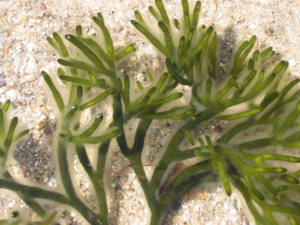 - Codium fragile, (pictured at right, in a photo taken July 28, 2001, at Sand Cove beach), has greatly expanded its range over the last century, most intensively over the last few decades. It has been an eye-catching and rapidly expanding addition to the seaweeds seen along North Atlantic coastlines, both eastern and western sides. A rare feature among the larger, fleshy seaweeds,
Codium hosts a form of cyanobacteria within its tissue that fixes atmospheric nitrogen and thereby partially provides the N needed by the algae. This feature gives
Codium a possible advantage over the other larger perennial seaweeds, such as kelp and rockweed, in a situation of N-shortage. As mentioned previously,
Codium fragile is also a more efficient N-scavenger from seawater, since it can use more different N-species than can most other seaweeds. But scavenging success is limited by the total amount of N in the seawater, and the facility for nitrogen-fixation by this plant can only supply about 7% of its total nitrogen requirement (Lobban and Harrison, 1994). Codium fragile has one final strategy to obtain the needed fertilizer, however.
- Codium fragile, (pictured at right, in a photo taken July 28, 2001, at Sand Cove beach), has greatly expanded its range over the last century, most intensively over the last few decades. It has been an eye-catching and rapidly expanding addition to the seaweeds seen along North Atlantic coastlines, both eastern and western sides. A rare feature among the larger, fleshy seaweeds,
Codium hosts a form of cyanobacteria within its tissue that fixes atmospheric nitrogen and thereby partially provides the N needed by the algae. This feature gives
Codium a possible advantage over the other larger perennial seaweeds, such as kelp and rockweed, in a situation of N-shortage. As mentioned previously,
Codium fragile is also a more efficient N-scavenger from seawater, since it can use more different N-species than can most other seaweeds. But scavenging success is limited by the total amount of N in the seawater, and the facility for nitrogen-fixation by this plant can only supply about 7% of its total nitrogen requirement (Lobban and Harrison, 1994). Codium fragile has one final strategy to obtain the needed fertilizer, however. 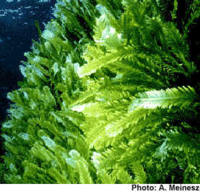 - Caulerpa taxifolia, pictured at right in a photo from NOAA, has invaded and taken over large areas of coastal seabed in the Mediterranean, and has spread to areas of the North East Atlantic coast, Australian waters, and, recently, has been found off California. Apparently a mutant strain, of what was originally a tropical algae, was developed in the aquarium trade, and it has proven to be highly adept at colonizing today’s sub-tropical ocean. With a proven ability to thrive in nutrient-enriched and nutrient-depleted waters both, the mutant
Caulerpa poses a serious threat to biodiversity in the areas that it invades. Its ability to thrive in nutrient-depleted waters may prove to be
Caulerpa’s strongest asset in today’s marine environment. A "siphonophore,"
Caulerpa draws nutrients up from within the bottom sediment, in the style of land plants, rather than the usual macroalgae that is "rooted" only by a holdfast and must absorb all nutrients directly from the surrounding seawater. Caulerpa taxifolia may have yet another trump card in the competition for nitrogen, at least one species has been shown to host a nitrogen-fixing strain of cyanobacteria in its tissue (Williams, 2000).
- Caulerpa taxifolia, pictured at right in a photo from NOAA, has invaded and taken over large areas of coastal seabed in the Mediterranean, and has spread to areas of the North East Atlantic coast, Australian waters, and, recently, has been found off California. Apparently a mutant strain, of what was originally a tropical algae, was developed in the aquarium trade, and it has proven to be highly adept at colonizing today’s sub-tropical ocean. With a proven ability to thrive in nutrient-enriched and nutrient-depleted waters both, the mutant
Caulerpa poses a serious threat to biodiversity in the areas that it invades. Its ability to thrive in nutrient-depleted waters may prove to be
Caulerpa’s strongest asset in today’s marine environment. A "siphonophore,"
Caulerpa draws nutrients up from within the bottom sediment, in the style of land plants, rather than the usual macroalgae that is "rooted" only by a holdfast and must absorb all nutrients directly from the surrounding seawater. Caulerpa taxifolia may have yet another trump card in the competition for nitrogen, at least one species has been shown to host a nitrogen-fixing strain of cyanobacteria in its tissue (Williams, 2000).
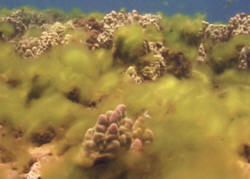 - Cladophora is increasing. (Photo at right borrowed from