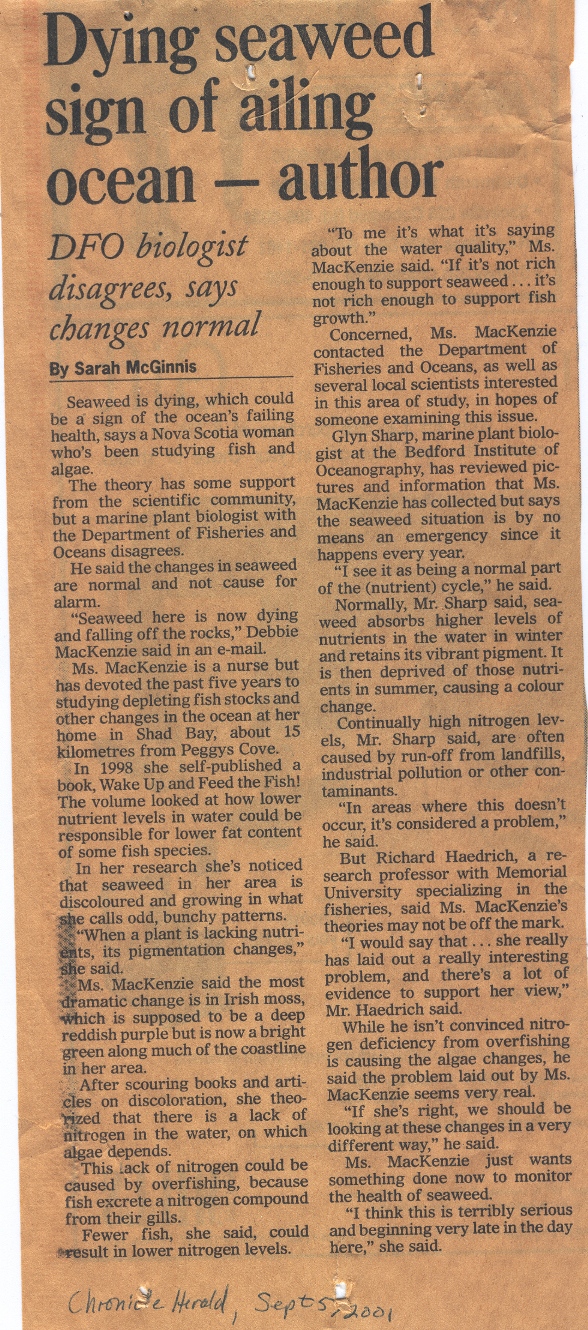
Dying seaweed sign of ailing ocean - author

Wednesday, September 5, 2001 Back The Halifax Herald Limited

Dying seaweed sign of ailing ocean - author

DFO biologist disagrees, says changes normal

By Sarah McGinnis

Seaweed is dying, which could be a sign of the ocean's failing health, says a Nova Scotia woman who's been studying fish and algae.

The theory has some support from the scientific community, but a marine plant biologist with the Department of Fisheries and Oceans disagrees.

He said the changes in seaweed are normal and not cause for alarm.

"Seaweed here is now dying and falling off the rocks," Debbie MacKenzie said in an e-mail.

Ms. MacKenzie is a nurse but has devoted the past five years to studying depleting fish stocks and other changes in the ocean at her home in Shad Bay, about 15 kilometres from Peggys Cove.

In 1998 she self-published a book, Wake Up and Feed the Fish! The volume looked at how lower nutrient levels in water could be responsible for lower fat content of some fish species.

In her research she's noticed that seaweed in her area is discoloured and growing in what she calls odd, bunchy patterns.

"When a plant is lacking nutrients, its pigmentation changes," she said.

Ms. MacKenzie said the most dramatic change is in Irish moss, which is supposed to be a deep reddish purple but is now a bright green along much of the coastline in her area.

After scouring books and articles on discoloration, she theorized that there is a lack of nitrogen in the water, on which algae depends.

This lack of nitrogen could be caused by overfishing, because fish excrete a nitrogen compound from their gills.

Fewer fish, she said, could result in lower nitrogen levels.

"To me it's what it's saying about the water quality," Ms. MacKenzie said. "If it's not rich enough to support seaweed . . . it's not rich enough to support fish growth."

Concerned, Ms. MacKenzie contacted the Department of Fisheries and Oceans, as well as several local scientists interested in this area of study, in hopes of someone examining this issue.

Glyn Sharp, marine plant biologist at the Bedford Institute of Oceanography, has reviewed pictures and information that Ms. MacKenzie has collected but says the seaweed situation is by no means an emergency since it happens every year.

"I see it as being a normal part of the (nutrient) cycle," he said.

Normally, Mr. Sharp said, seaweed absorbs higher levels of nutrients in the water in winter and retains its vibrant pigment. It is then deprived of those nutrients in summer, causing a colour change.

Continually high nitrogen levels, Mr. Sharp said, are often caused by run-off from landfills, industrial pollution or other contaminants.

"In areas where this doesn't occur, it's considered a problem," he said.

But Richard Haedrich, a research professor with Memorial University specializing in the fisheries, said Ms. MacKenzie's theories may not be off the mark.

"I would say that . . . she really has laid out a really interesting problem, and there's a lot of evidence to support her view," Mr. Haedrich said.

While he isn't convinced nitrogen deficiency from overfishing is causing the algae changes, he said the problem laid out by Ms. MacKenzie seems very real.

"If she's right, we should be looking at these changes in a very different way," he said.

Ms. MacKenzie just wants something done now to monitor the health of seaweed.

"I think this is terribly serious and beginning very late in the day here," she said.


Back
Copyright © 2001 The Halifax Herald Limited

      Home            About          What's New         Article Index        Contact
      Home            About          What's New         Article Index        Contact